
• God Save the Queen!

    The queen must die, we decided this weekend.

    Hive #1 has been our best hive for a couple of years. This year, our first year to harvest honey, we took 5 supers off that single hive, a little more than 10 gallons. It’s the towering “beescraper” on the left, below. By mid-July when we harvested, we added yet another deep body to the stack so that the bees wouldn’t swarm for lack of space. We named the queen  Imelda because we imagined that the queen of such a massive bee city would have a lot of shoes in her bee closet. It has been a mega-city, a bee-tropolis. But today, we planned to kill the queen.

    Imelda's hive

    We’ve been going through the hives lately to make sure they’re adequately prepared for winter, and we found that hive #1 had no eggs or small brood, a sign that the queen had failed. (Eventually, she just runs out of eggs.) Usually, the bees take care of succession themselves, starting a new queen when the old one begins to falter, but it’s too late this season for them to manage, so we planned to pick up a new queen Monday. First, though, we’d have to assassinate Imelda so that her workers would be ready to transfer their allegiance.

    I was reluctant to re-queen the hive–I’d much rather let the bees raise one of her daughters since she clearly has good genetics. So we were very pleased to find two frames full of Imelda’s eggs and small brood this afternoon–and Imelda herself, still fat and glowing.

    Guess she just got back from summer vacation. No sign of her shoes, though.
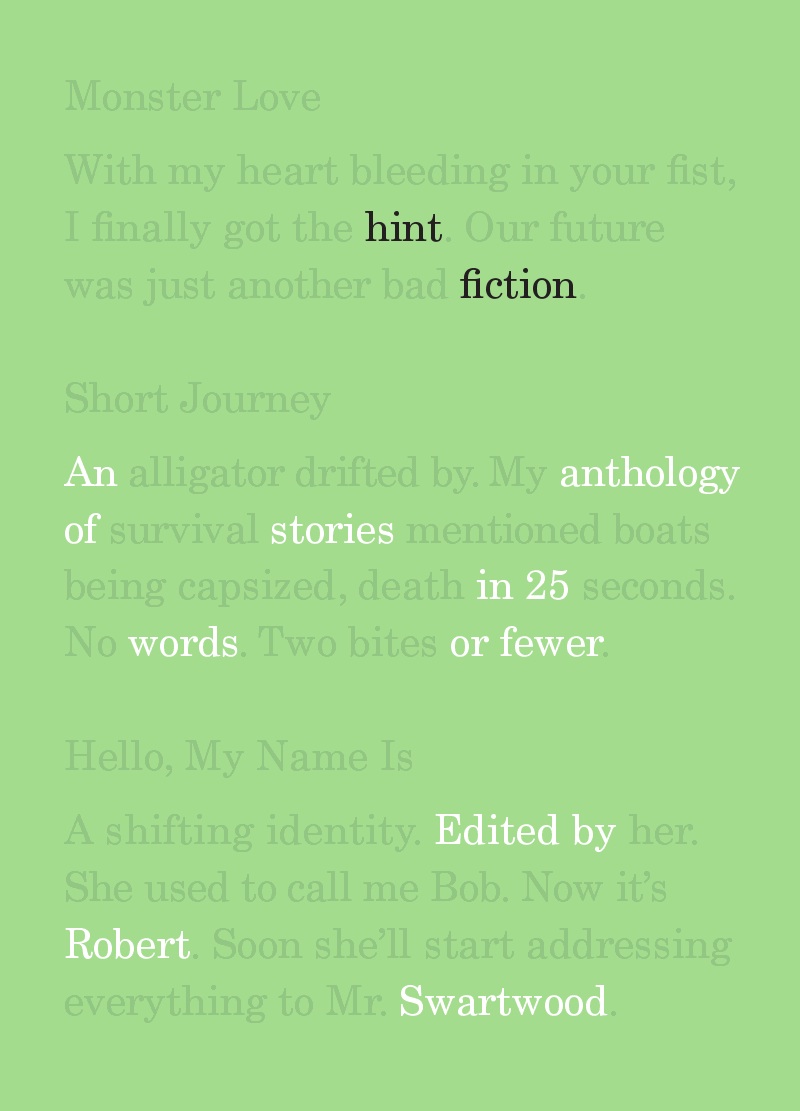
  • Hint Fiction

    I rub shoulders with greatness in Robert Swartwood’s forthcoming anthology of Hint Fiction.

    Here’s the Amazon blurb:
    A story collection that proves less is more. The stories in this collection run the gamut from playful to tragic, conservative to experimental, but they all have one thing in common: they are no more than 25 words long. Robert Swartwood was inspired by Ernest Hemingway’s possibly apocryphal six-word story—”For Sale: baby shoes, never worn”—to foster the writing of these incredibly short-short stories. He termed them “hint fiction” because the few chosen words suggest a larger, more complex chain of events. Spare and evocative, these stories prove that a brilliantly honed narrative can be as startling and powerful as a story of traditional length. The 125 gemlike stories in this collection come from such best-selling and award-winning authors as Joyce Carol Oates, Ha Jin, Peter Straub, and James Frey, as well as emerging writers.

    (I’m one of those “emerging” writers.)

  • Because I don’t have enough else to do, and to break my ten-year poetry-writing block, I’m auditing a poetry course this semester with the inimitable Michael Ann Courtney. She has us playing with all sorts of forms. Last week, one of the (many) assignments was a “terribly clever double dactyl.”

    Besides constraints of rhyme and meter, the doubt dactyl requires an opening line of repetitive nonsense and a second line that consists of someone’s name. One of the lines in the second stanza must be a single double-dactylic word. The whole thing should have some snooty literary or philosophical allusions.

    Mine, naturally, dealt with the Martyrs Mirror.

    I’ll publish it here, since it certainly doesn’t deserve a broader audience.

      Toothsomely, gruesomely

      Thieleman J. van Braght

      drafted his indices:

      martyr parades.

      Gougings on drownings on

      tongue screws on flames for their

      Mennohistorical

      last escapades.