Feeds:
Posts
Comments

Hint Fiction

I rub shoulders with greatness in Robert Swartwood’s forthcoming anthology of Hint Fiction.
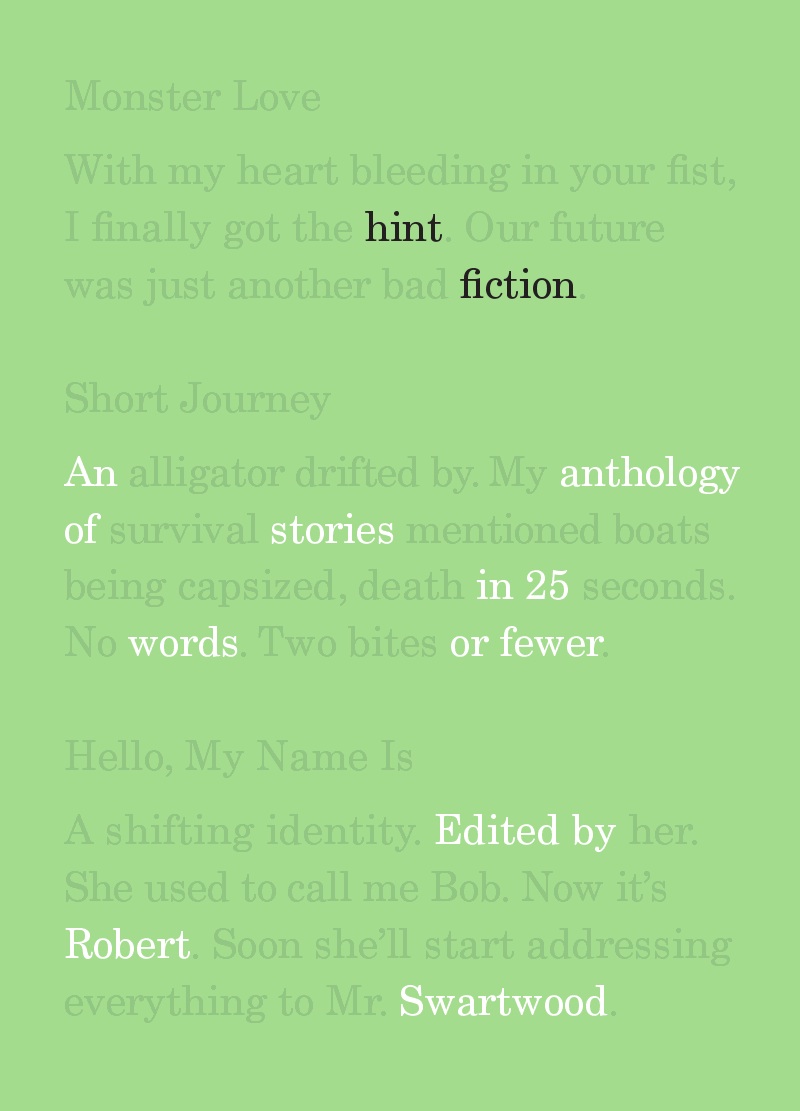
Here’s the Amazon blurb:
A story collection that proves less is more. The stories in this collection run the gamut from playful to tragic, conservative to experimental, but they all have one thing in common: they are no more than 25 words long. Robert Swartwood was inspired by Ernest Hemingway’s possibly apocryphal six-word story—”For Sale: baby shoes, never worn”—to foster the writing of these incredibly short-short stories. He termed them “hint fiction” because the few chosen words suggest a larger, more complex chain of events. Spare and evocative, these stories prove that a brilliantly honed narrative can be as startling and powerful as a story of traditional length. The 125 gemlike stories in this collection come from such best-selling and award-winning authors as Joyce Carol Oates, Ha Jin, Peter Straub, and James Frey, as well as emerging writers.

(I’m one of those “emerging” writers.)
Because I don’t have enough else to do, and to break my ten-year poetry-writing block, I’m auditing a poetry course this semester with the inimitable Michael Ann Courtney. She has us playing with all sorts of forms. Last week, one of the (many) assignments was a “terribly clever double dactyl.”

Besides constraints of rhyme and meter, the doubt dactyl requires an opening line of repetitive nonsense and a second line that consists of someone’s name. One of the lines in the second stanza must be a single double-dactylic word. The whole thing should have some snooty literary or philosophical allusions.

Mine, naturally, dealt with the Martyrs Mirror.

I’ll publish it here, since it certainly doesn’t deserve a broader audience.

    Toothsomely, gruesomely

    Thieleman J. van Braght

    drafted his indices:

    martyr parades.

    Gougings on drownings on

    tongue screws on flames for their

    Mennohistorical

    last escapades.

Hymn Sing

Instead of celebrating the start of a new semester of teaching with my traditional box of Breyer’s cookie dough ice cream, I celebrated with a community hymn sing at Park View Mennonite church tonight. On the whole, I think it’s a healthier approach. An hour and a half of deep breathing, wrapped in intricate harmonies, with a song leader who wasn’t afraid to keep the tempo fast.

We were near the front, so I didn’t get  a great look at the crowd, but I think Jason and I were among the youngest participants. Which is a pity. There’s nothing like four-part harmony, Mennonite style. (Though, to be fair, the Brethren, Methodists, and others made a showing for the hymn sing.)

So what if the theology doesn’t always sync perfectly with my postmodern faith? I sang these songs standing on a pew as a kid, belting out “Old Mother Brown is Sleeping Sound” (that would be “All Other Ground is Sinking Sand”), caught up in the joy of the people around me and the beauty of the music. It still works. And, I confess, it works best when I don’t bother to update all those male pronouns for God, and just sing it like I first learned it.

The old hymns combine darn good music and sweet, old-fashioned poetry. I really don’t care much for “praise” music, though I do like the multicultural music in the newer Mennonite hymn collections.
Compare:

You, You love, love….dribble, dribble…

move me, move me…dribble, dribble….

yeah, Baby! Jesus!

With:

Could we with ink the ocean fill,
And were the skies of parchment made,
Were every stalk on earth a quill,
And every man a scribe by trade;
To write the love of God above
Would drain the ocean dry;
Nor could the scroll contain the whole,
Though stretched from sky to sky.

And sorry, dear reader, if you prefer the dribbly music. I’m past thirty now. I’m allowed to curmudge.

Tonight I cooked pork chops for the first time in my life. And they were good.

I’m not usually a big fan of meat. Until I married Jason, I was practically a vegetarian, but he’s a farm boy and likes to sink his teeth into once-living flesh now and then. Since we started butchering our own poultry, we’ve had a decent supply of chicken and duck, and I’ve learned to enjoy meat with a history.

A couple of weeks ago, we visited family in southern Indiana and stopped to see old friends at Brambleberry Farm. We took them honey from our bees and five young Muscovy ducks. In turn, they gave us several nut trees from their nursery, some seed garlic, and a selection of cuts from some of their American Guinea Hogs. Thus, tonight’s pork chops.

I dredged the chops in flour, salt, and pepper, and did a simple saute in butter and olive oil. The meat had more body than the pork chops I’ve encountered before, almost like steak and, as Jason said, “It has flavor.” An incredibly rewarding flavor. In the end, I picked up the remains of the chop and gnawed at the bone like a barbarian, unwilling to let a morsel go to waste.

I wonder if they’ll want more honey next year?

*Insert reality check here: as all of us who care about global warming know, it’s wisest to shun meat. Meat remains a once-a-week treat for us, but what a treat when it comes with a history!

*Reality check B: the five Muscovy ducks were still young, small enough to all fit into a large cardboard box. I don’t recommend traveling with full-grown ducks. Though some do.

This summer, I visited Prince Edward Island, the stomping grounds of L. M. Montgomery, who forever shaped my young imagination with her Anne and Emily books. Her own life, however, was rather sad, in spite of the gorgeous surroundings.

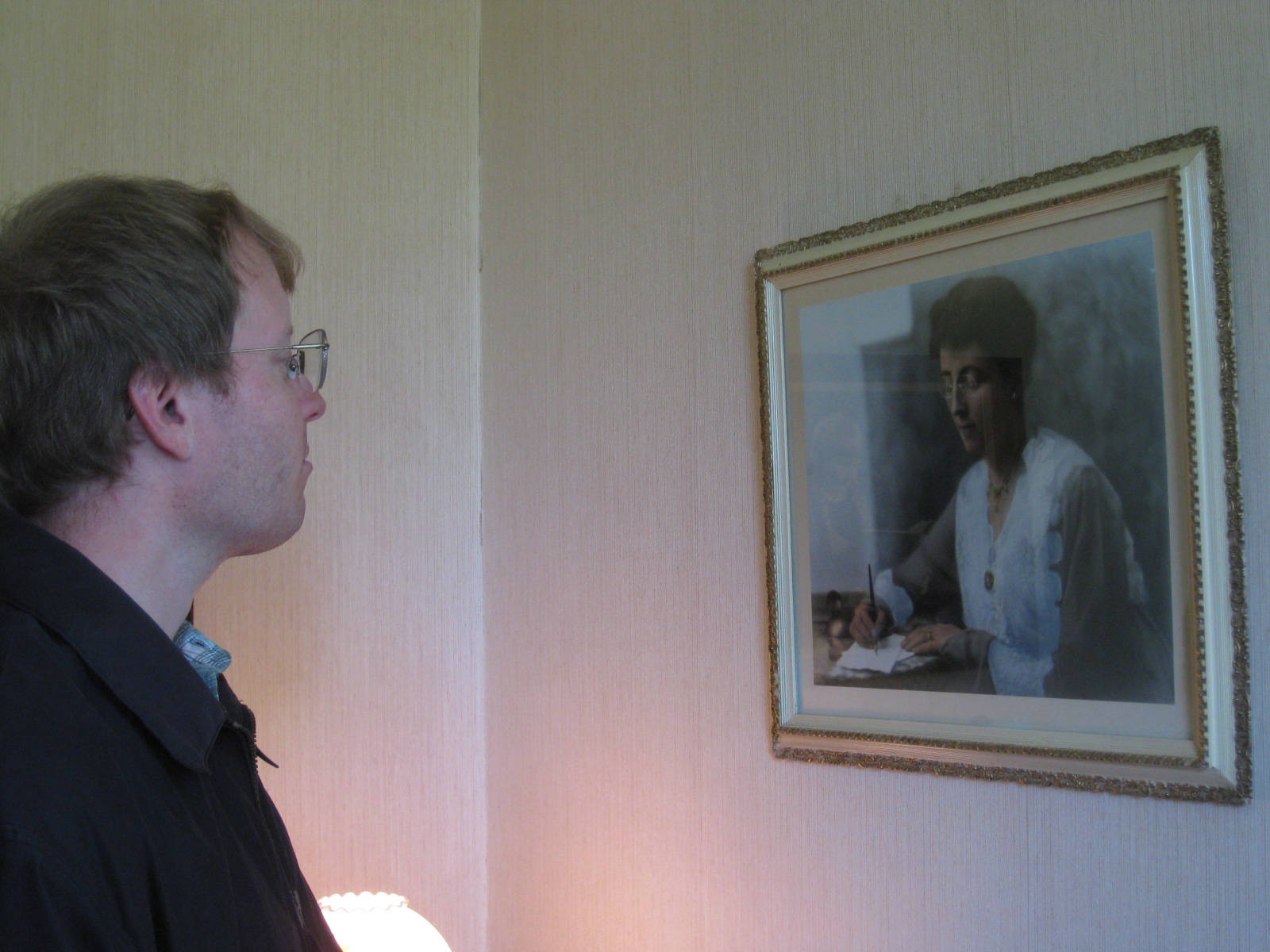
Here, my better half bonds with Lucy Maude.

We also made the obligatory pilgrimage to “Green Gables.”

Our friends re-enacted the classic slate-smashing scene (Jessica as Anne, Tom as Gilbert) from Anne of Green Gables at the Blue Winds Tea Room.

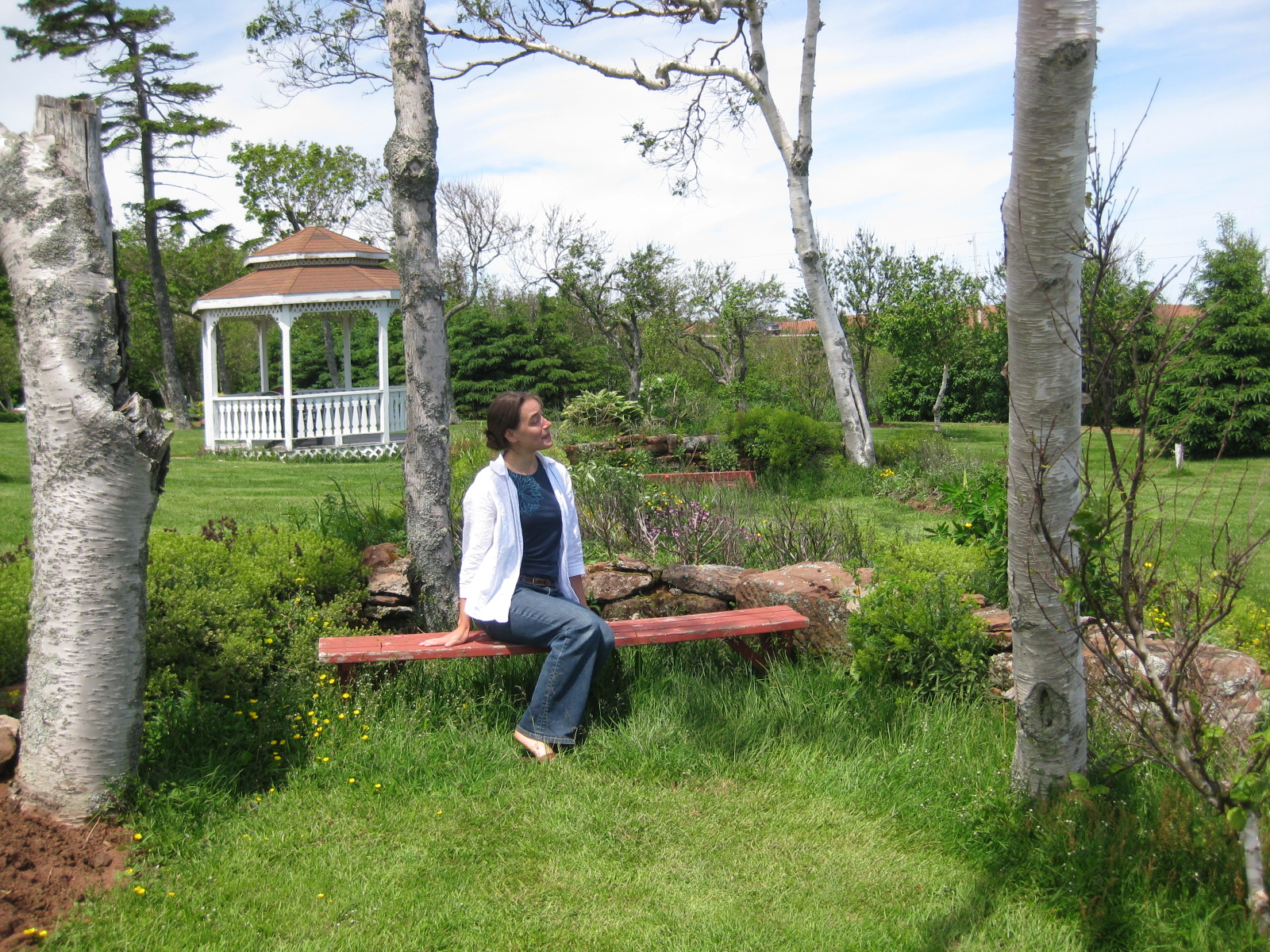
At “Shining Waters” I tried to look the part of an inspired young authoress.

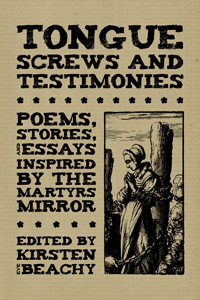
My anthology should be out by December! Click on the image to pre-order from Herald Press. Or click here to visit the book’s website: www.martyrstock.wordpress.com, where you can access author webpages, additional resources, and all sorts of material I promise to post in the very near future.

Read a bit of my work over at The Tusculum Review.

On the twelfth day of the first year of the Obama administration, as the nation’s economy continued to crumble, we opened our beehive and found the colony dead.

Through most of the winter, we left the bees alone so as not to release the heat they generated huddled between their walls of honey. But when the temperature rose into the 50s, the bees could bear the air enough to take brief cleansing flights, and we dared to open the hive for a few minutes. We had plenty of unseasonable warmth this year—sunny days when the bees flew to gather maple sap, risen during the freezing night, draining through holes the sapsucker drilled through the bark. No bees were flying the afternoon we opened the hive, but we assumed they’d finished their business in the warmest part of the day. A few dead bees lay scattered below the hive, evidence of the cleaning efforts of the workers.

Read on.